Flexible
MJF printing provides exceptional design freedom and robust results, allowing for complex, production-ready parts that meet cross-industry requirements

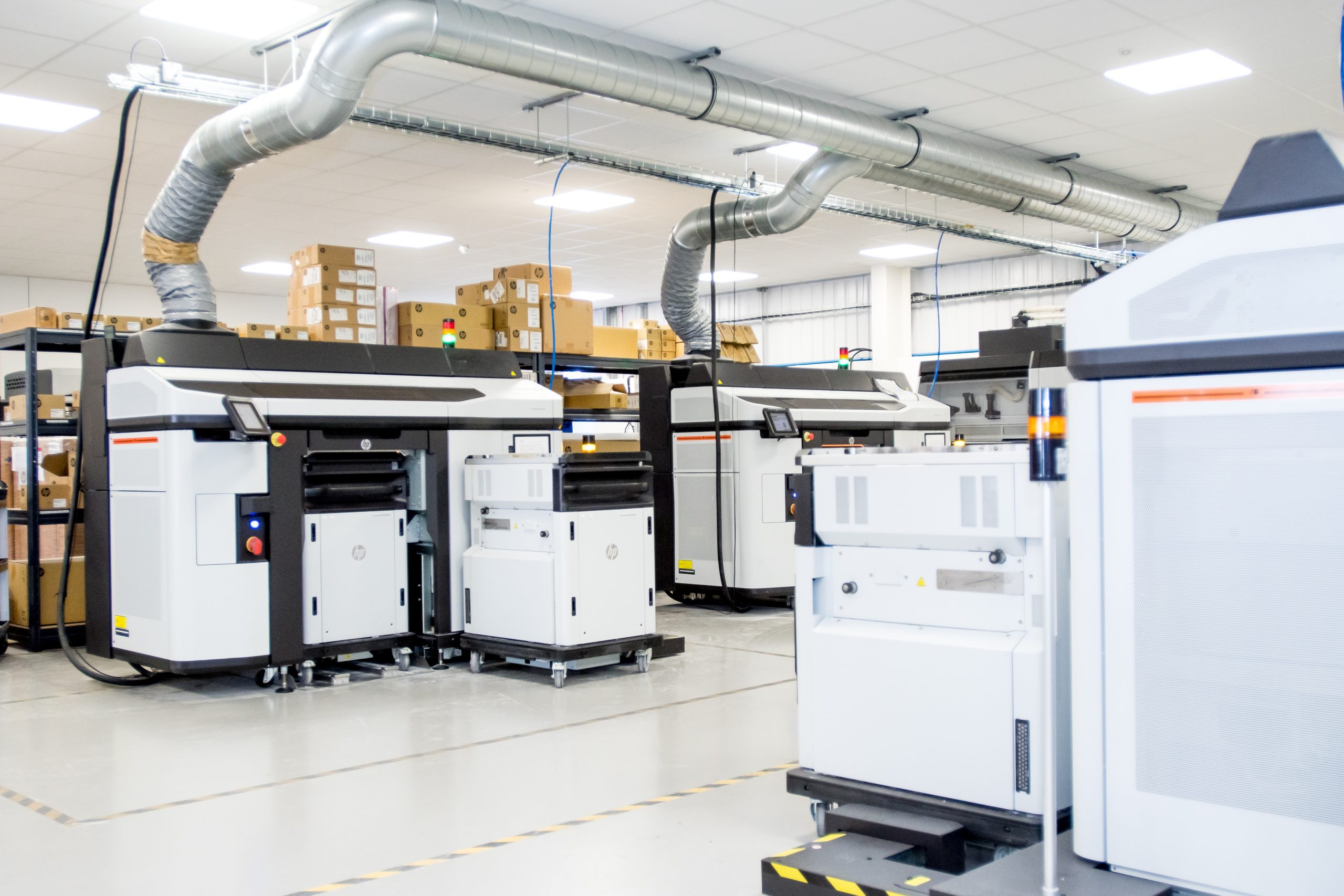
AMufacture is the UK’s leading production partner specialising in HP Multi Jet Fusion (MJF) printing.
This fast 3D printing method produces durable, functional parts with excellent mechanical properties and fine surface details. For our collaborators, that means production-ready outcomes at minimal cost and optimal speed and scale.
MJF printing provides exceptional design freedom and robust results, allowing for complex, production-ready parts that meet cross-industry requirements
With unrivalled speed and consistent, volume-independent lead times, MJF yields scalable production with no costly tooling and all the freedom of rapid, iterative development.
MJF is fundamentally designed to be economical and ecological. It allows for production at scale with cost-effective material reuse and almost zero waste.
We become your end-to-end production partner. Harness cross-industry expertise and best-in-class MJF 3D printing technology, from design optimisation to post-processing.
HP’s Multi Jet Fusion is considered the industry standard for powder bed fusion (PBF) printing. It combines inkjet-deposited fusing agents and detailing agents with infrared light to selectively fuse thermoplastic powder layer by layer.
Unlike selective laser sintering (SLS), which traces each cross-section with a laser point, MJF applies agents across an entire solid layer simultaneously. It then fuses treated areas with a heat source passing over the build chamber.
The process delivers consistent isotropic mechanical properties, meaning tensile strength and impact resistance remain nearly uniform across all axes. This makes MJF-printed parts predictable for engineering applications where directional strength matters.
HP introduced Multi Jet Fusion commercially around 2016, evolving it from rapid prototyping into genuine production runs. MJF 3D printing has advanced the additive manufacturing industry through an efficient, scalable and sustainable manufacturing method.
Primary plastic materials include PA12 nylon powder, PA11, TPU for flexible applications, and glass- or mineral-filled nylons for enhanced stiffness and thermal performance.
MJF printing is at the bleeding edge of additive manufacturing, quickly producing parts with excellent mechanical properties and fine feature resolution.
Combined with AMufacture’s best-in-class manufacturing capabilities and end-to-end, real-time production visibility, this allows for fast, scalable and repeatable production runs without the tooling costs and lead times of injection moulding.
Layer-wide fusion delivers uniform thermal distribution, ensuring consistent mechanical properties across all axes. That includes minimising Z-axis weakness, a common challenge with SLS printing.
Layer-level fusion completes builds faster. The process repeats efficiently, spreading nylon powder, depositing agents via an inkjet array, fusing with infrared light and completing layers in seconds.
MJF 3D printing is optimised for production at scale. Build times remain the same, whether you’re producing one prototype or 1,000 production-ready parts. That means reliable scheduling for you and dependable delivery for your customers.
With MJF, you can achieve greater design complexity with less post-processing and without compromising the pace of production. Unfused powder supports complex geometries, overhangs and internal channels, eliminating the need for dedicated supports.
MJF is proven and trusted across industry verticals. With dimensional accuracy of ±0.3% and tolerances around ±0.2 to 0.3 mm, it meets demanding functional requirements for automotive, aerospace, medical and marine applications.
MJF printing creates nearly zero waste and enables cost-effective material reuse. PA12 powder can be refreshed by mixing around 80% used powder with 20% new powder. SLS, by contrast, typically allows for recyclability rates of 50 to 70%.
AMufacture goes beyond contract manufacturing. When you partner with us, our industry-leading technologies and expertise become an extension to your workflow, enabling fast, consistent and repeatable production at scale.

Our partners enjoy expert support through every stage of the MJF production process. We’re strategic collaborators, working with clients across design, production and post-processing to optimise efficiency, quality and value.

At AMufacture, we constantly advance our capabilities to meet and exceed your requirements. We are the first UK contract manufacturer to operate the HP 5420W 3D Printer, capable of producing engineering-grade white parts.
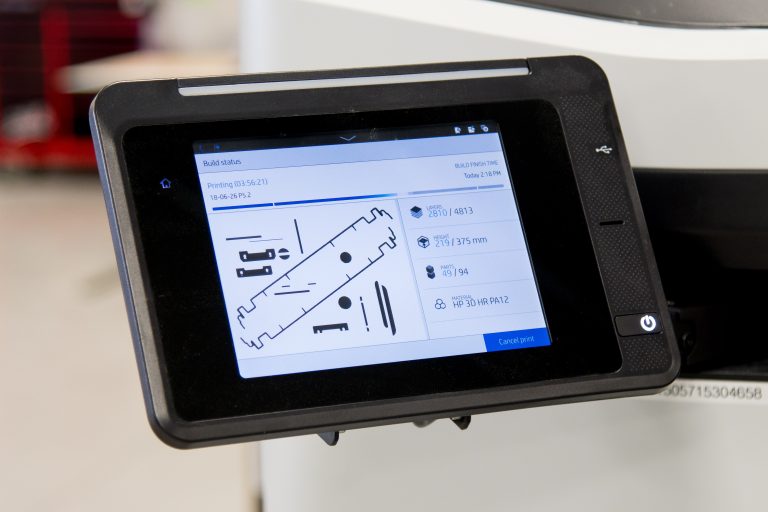
Let our digital platform be your single source of truth. As an AMufacture partner, you can track your parts in real time through every stage of production and build an IP-secure Digital Warehouse for seamless reordering and iteration.

At AMufacture, we advance our capabilities to keep pace with the most demanding industry requirements. That includes investing in bleeding-edge Multi Jet Fusion 3D printing systems that support fast, flexible and automated production.
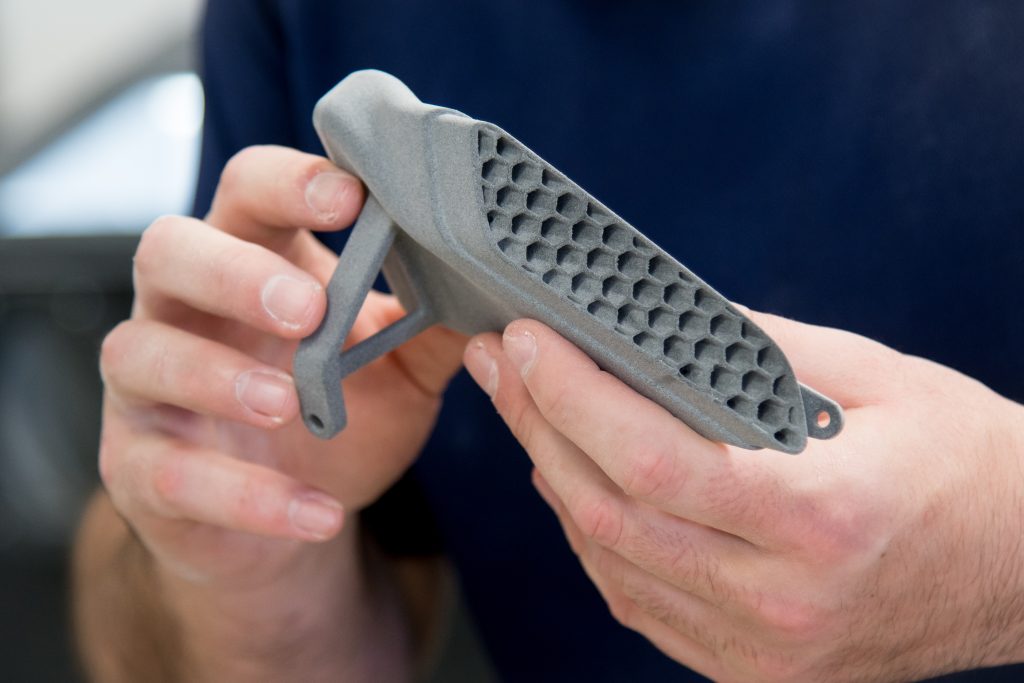
A key benefit of MJF printing is its minimal post-processing requirements. However, some finishing is typically required for refinement and performance optimisation.
As your end-to-end production partner, AMufacture offers a wide range of in-house finishing capabilities to take your assemblies to the next level. Our services range from ISO-certified dyeing to full technical assembly. For MJF components, the most beneficial secondary operations include:
AMufacture’s HP 3D printing services support partners across industry verticals to scale production, accelerate innovation and ensure compliance. We help clients deliver against complex briefs and create end-use parts for a wide range of industry-specific applications.

AMufacture’s Multi Jet Fusion printing process builds parts through five stages:
Learn more with our ‘Complete Guide to MJF Printing‘.
MJF 3D printing technology produces highly accurate, functional parts with fine details, sharp edges and a smooth surface. It allows for complex geometries without the need for support structures, as the unfused powder acts as support.
Choose MJF printing for faster turnaround, better isotropy, finer details, and medium-to-high volume cost efficiency.
Choose SLS printing for larger parts, broader materials, or lighter starting colours.
| Factor | MJF | MJF 5420 (White Isotropic) | SLS |
|---|---|---|---|
| Fusion mechanism | Fusing agents + infrared light | Fusing agents + infrared light | Scanning laser |
| Speed | Faster (layer-wide exposure) | Faster (layer-wide exposure) | Slower (point-by-point tracing) |
| Mechanical isotropy | Excellent (uniform in all axes) | Excellent (uniform in all axes) | Good (some Z-axis weakness) |
| Detail resolution | Finer (~0.5 mm minimum feature size) | Finer (~0.5 mm minimum feature size) | Slightly coarser (~0.75-0.8 mm) |
| Material range | Expanding but narrower | Nylon PA12 with enhanced aesthetics | Broader (more filled nylons, high-temp options) |
| Default colour | Grey-black | White | White/grey (easier dyeing) |
| Surface finish | Slightly smoother as-printed | Smooth matte finish, improved surface quality | Grainier |
| Build volume | Moderate | Moderate | Some machines offer larger volumes |
| Powder reuse | Very high (up to 100%) | Very high (up to 100%) | High (typically 50-70%) |
Multi Jet Fusion offers robust thermoplastics suited to various needs:
MJF parts have a matte, grainy surface, yet vapour smoothing or vibro polishing can improve appearance. The default colour is grey-black due to the pigmentation of the fusing agent.
Understanding MJF’s process parameters is essential for optimising design.
MJF offers faster turnaround times compared to Fused Deposition Modelling (FDM) and Stereolithography (SLA). It can produce parts up to ten times faster than comparable FDM and SLS systems, according to internal testing by HP.
Post-processing with MJF is relatively light compared to other AM technologies. Parts are bead blasted to remove residual powder. Vibro polishing removes the grainy texture for a smooth finish. Vapour smoothing enhances elongation at break, impact resistance, and fatigue strength, and dyeing enhances visual appearance and helps with UV stability.
After MJF printing, the entire powder bed with the encapsulated parts is moved to a processing station, where an integrated vacuum removes most of the loose powder, recycling around 80%. This powder is used in the next print, resulting in almost zero waste.
MJF is designed to produce higher volumes of parts with great complexity, detail and structural integrity. It also offers greater design freedom, due to its support-free structures. It’s ideal for small and medium production runs of prototypes and commercial end-use parts.
With AMufacture’s best-in-class 3D printing fleet, you unlock more ways to deliver on production goals and bolster supply chain resilience.

A resin-based process that harnesses projected light to cure entire layers in one go, enabling rapid production of highly detailed parts.
Best for: fine detail, small parts, smooth finishes
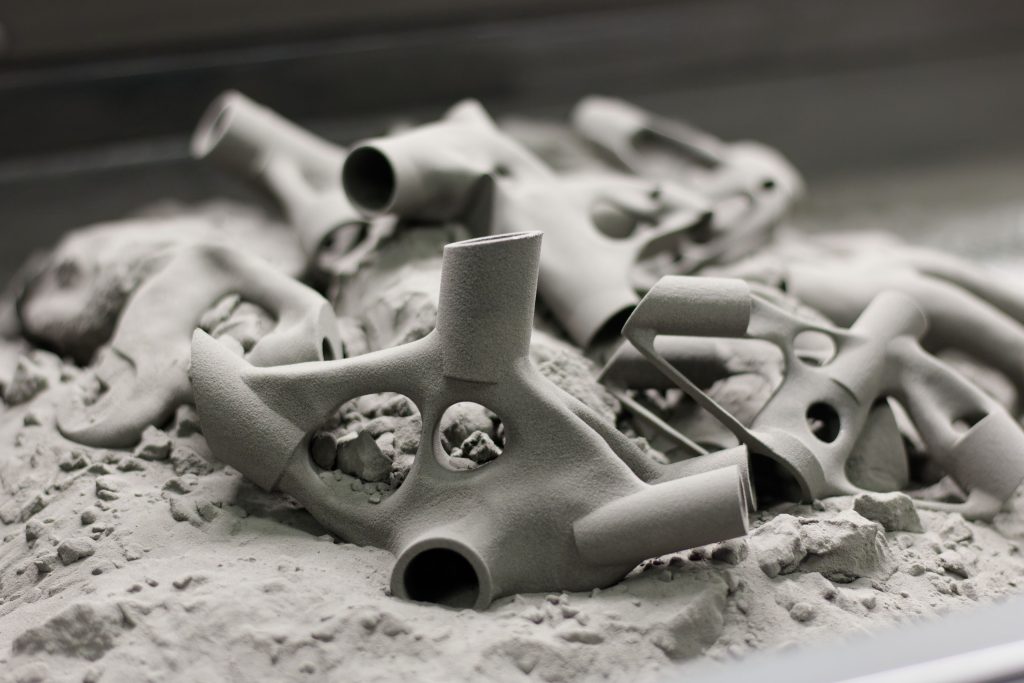
A powder-based process that uses a laser to fuse nylon materials into strong, functional parts without support structures.
Best for: large components, lighter colours, small production runs

A laser-based process that produces parts with exceptional surface quality and high accuracy.
Best for: accuracy, smooth finishes, visual prototypes
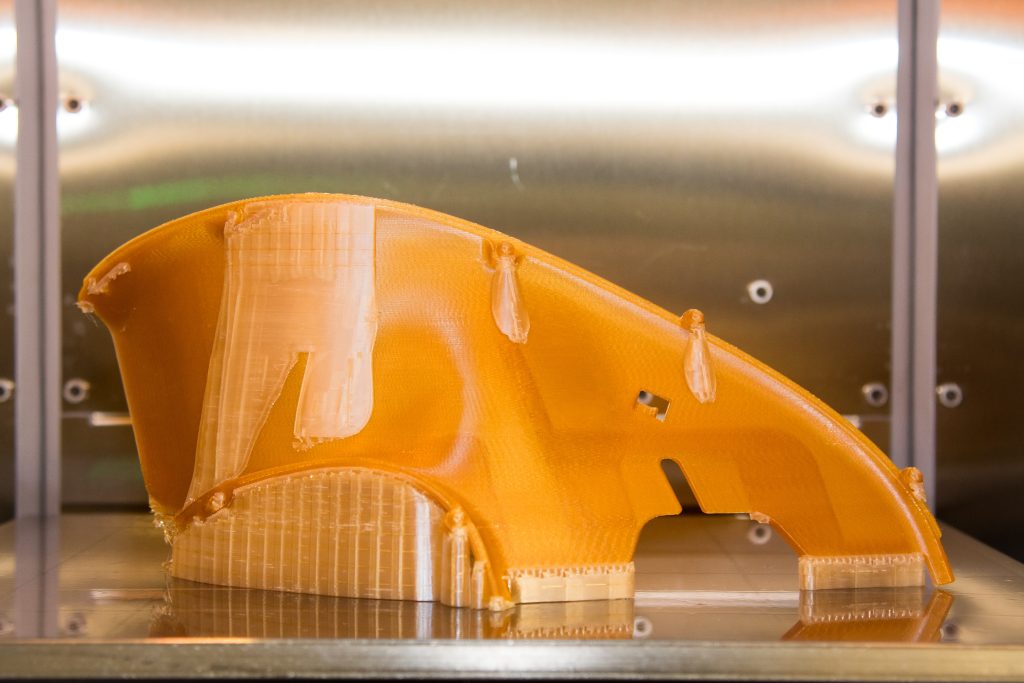
A material extrusion process that uses durable thermoplastics to build parts layer by layer.
Best for: large components, durability, tooling
If you have any questions about our services or would like to discuss your project with us, please don’t hesitate to contact us.
"*" indicates required fields